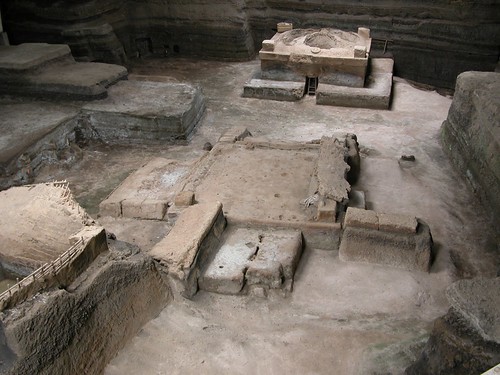
Dvaravati was an ethnic Mon kingdom occupying what is now much of central Thailand.


A Japanese anime song karaoke contest was held in Bangkok on Sunday. The event was organized by the Japanese embassy in Thailand.
16 finalists between the ages of 9 and 25 performed songs. They were chosen from more than 100 participants. Most of the finalists are studying Japanese and sang fluently in the language. Some of them danced energetically to the music as they sang.
Many young people wearing anime character costumes visited the venue, and took part in a photo event and an exhibition of anime items


Okay, I'm not familiar with my Ramayana but I'm fairly sure that this is a Yak in disguised to lure Phra Ram. Okay people always say that Khmer and Thai lakorn are the same. It is true that both theatre are related with the Khmer version being the predecessor. However, there fundamental differences in the music and acting and plot all together.
Oh, I get more death threats from a certian crazy Canadian but he didn't figure I'd put my system on moderation. Which brings me to another note. I welcome most comments on here (even condencending ones) but I don't tolerate this type of insanity.

 Culturally, the different linguistic groups are quite diverse. Both Mon and Khmer have heavy Indian influences as shown in the borrowing of Pali words, Theravada Buddhism, Architecture, and Clothing. Vietnamese on the other hand, had heavy Sinicization due to many years of domination by various Chinese Dynasty. As a result, Vietnamese draw from Mahayana Buddhism, have many cognates with Chinese (in particular Cantonese), and other Chinese elements. Despite this, the majority of Austro-Asiatic speakers still retain some indigenous cultural aspects such as different kinship structure and a tendency towards animism. (Pictures of Khmu people in Northern Laos.)
 The Khmer people established their fist kingdom as Funan as recorded by Chinese records. This later would be over thrown by Chenla and later Angkor. Angkor would later dominate large portions of modern day Vietnam, Thailand, Cambodia, and Laos. The Angkor dynasty would end due to internal changes as well as attacks from the newly formed Tai kingdom of Ayutthaya. This leads to a now Theravada kingdom and into a "dark age." Eventually, the Khmer people would go under French protectorate as a result of colonization. A few decades after independence from the French, they would face a civil war and a genocide at the hands of the Khmer Rouge. In modern times, Khmer people are the majority of the country of Cambodia but also have significant presence in Thailand and Vietnam. Khmers practice Theravada Buddhism, imported from Sri Lanka, with elements of Hinduism and animism. They use the Khmer script, a member of the Bhramic script family. Thai and Lao Scripts are descendants of Khmer script. Khmer legends claims that they are descendants of an Indian prince and a Naga princess. (Picture of a Khmer Royal Ballet dancer as Sovan Macha the mermaid who attempt to seduce Hanuman from the epic Ramayana.)
 The Viets are regarded to be one of the Yue peoples found in Chinese historical records. They would first go under domination from the Han dynasty, with subsequent Independence and revolts. They are again dominated by the Sui and Tang receiving independence in the Ngô Dynasty. By then end of the Trần Dynasty and Hồ Dynasty, they are again overtaken by the Ming. Eventually, they received independence again until the collapse of Nguyễn Dynasty under French occupation. Subsequently they go through independence and then the Vietnam War. They unify under the Communist regime but thaw towards free market economic system in the end of the 20th century. Viets are in the southern most part of China, they are the majority of Vietnam and have presence in Cambodia, and Laos. There is also a large number of Vietnamese in the United States due to the Vietnam War. Viets practice Mahayana Buddhism, Confucianism, Taoism, Cao Dao, and Catholicism. Vietnamese employs Quốc Ngữ which comprises of Latin characters to suit their phonology and was developed by missionaries. Historically, Vietnamese used Classical Chinese and Chữ Nôm which is a derivative of Chinese. Vietnamese legends claim that they are children of the Red Dragon. (Picture of a Viet woman in a Modern áo dài. Historically, female dress were similar to male dress. After French influences, female dress became more tight fitting to reveal the body. It is derived from the Manchu Qipao/Cheongsam from the Qing.)
 The Mon people had a several kingdoms in what is now modern day Myanmar. Their script would be adapted by the Burmese as their script. After they fall to the Burmese they would be scattered into modern day Thailand and Myanmar. In modern time, they represents on of the ethnic groups in Myanmar seeking independence. Mon are Theravada Buddhist with elements of animism. Mon use the mon script, which is a member of the Bhramic family. Burmese, Shan, Dai, and Lana are derived from Mon script. (Picture of a Mon celebration. Note that the dress worn is similar to dress found throughout Southest Asia (continental and insular) due to Indian influences.)
 Other Austro-Asiatic people include the Khmu, the Palaung, Orang Asli in Malaysia, Nicobar natives, Munda hill tribes, and numerous other small ethnic groups. Their cut lure varies greatly depending on environment and location. For the most part most of these groups lack their own writing system. They are also often politically marginalized. Religious affiliations vary from tribe to tribe. (Picture of Munda women.)
 (Picture of Orang Asli women. Asli are the indigenous people of peninsular Malaysia. They are often grouped with other indigenous people in Sarawak and Sabah although linguistically those people are not related to the Asli.)