Posts mit dem Label Food werden angezeigt. Alle Posts anzeigen

Sonntag, 10. Oktober 2010

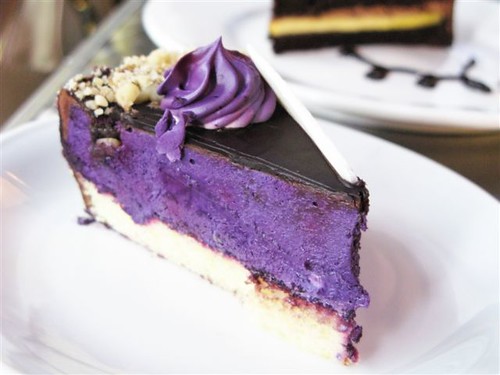
Ube macapuno cake


2 1/2 cups cake flour
3 teaspoons baking powder
1 teaspoon salt
1 cup ube (purple yam), cooked and finely grated
3/4 cup milk
1 teaspoon vanilla extract
1/2 cup corn syrup
7 egg yolks, lightly beaten
1/2 cup vegetable oil
7 egg whites
1 teaspoon cream of tartar
1 cup white sugar
6 drops red food color
6 drops blue food coloring
1 (12 ounce) jar macapuno (coconut preserves)

1 cup evaporated milk, chilled
3/4 cup white sugar
1 cup butter, softened
1 drop violet food coloring


Preheat oven to 325 degrees F (165 degrees C). Line bottoms of 3 - 9 inch pans with parchment paper, but do not grease. Mix together the flour, baking powder, and salt; set aside.
Place grated ube in a large bowl. Mix together 3/4 cup milk and 1 teaspoon vanilla; gradually blend into ube until smooth. Blend in corn syrup, egg yolks, and oil. Beat in flour mixture until smooth; set aside. In a large glass or metal mixing bowl, beat egg whites with cream of tartar until foamy. Gradually add sugar, then red and blue food coloring, continuing to beat until stiff peaks form. Fold 1/3 of the whites into the batter, then quickly fold in remaining whites until no streaks remain. Pour batter into prepared pans. Bake in the preheated oven for 30 to 35 minutes, or until the center of cake bounces back when lightly tapped. Invert pans on a wire rack and let cool upside down. When cool, run a knife around the edges to loosen cake from pans. Fill between layers with coconut preserves, then frost top and sides with butter icing.
To make Butter Icing: Combine evaporated milk and 3/4 cup sugar. set aside. Cream butter until light and fluffy; gradually add sugar mixture, and continue beating to desired spreading consistency. Add food color, one drop at a time until desired tint is achieved.

Donnerstag, 26. August 2010

Ethnography

This editions of Ethnography, I'm going to focus on the negotiation of group identity.


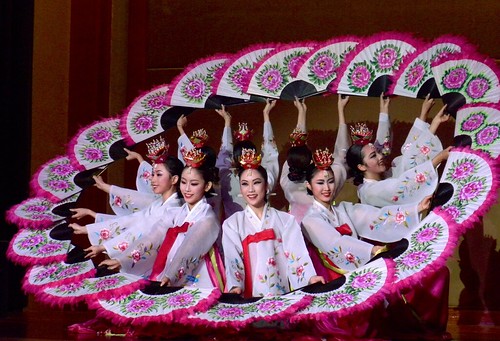
First let's start off with a Korean dance called Buchaechum (부채춤). Buchaechum has become very synonymous with various Korean celebrations ranging from Buddha's birthday to simple Church days. Buchaechum is a kinda of iconic of Korean culture (esepecially in it's design, make-up, and hanbok), so it is use to represent Korea in a universal way.


Next is Jeruselam Pride. Pride has always been been representing the LGBT culture in the most fabulous fasion possible through the body of the participants, the colors, and the music. But for Jeruselam's Pride, there is an added emphasis on the role of the secular Jewish community in promoting LGBT people as part of their own identity.


Food is always a way to declare one's ethnic identity, and therefore ethnic enclaves will have their food stuff served and readily availiable. Here is a sample of some of the food one can find in Little Phnom Penh in Long Beach, California. Long Beach is one of the biggest Khmer-American community.


The Cahuilla, like many other Native American tribes, seek to find a lost identity by riviving old arts and costoms.

Halayang Ube: Ito ay isang Filipino pagkain


1 kilo ng Ube ugat (kilograms of purple yam)

1 tasa ng gatas ebaporada (cup of evaporated milk)

2 tasa ng gatas lumapot (cup of condense milk)

1 / 2 tasa ng mantikilya o margarina (cup of butter or margarine)

1 / 2 kutsarita ng banilya (teaspoon of vanilla)


On a pot, boil the unpeeled ube yam in water and simmer for 30 minutes. Drain and let cool. Peel and finely grate the ube yam. Heat a big wok in medium heat. Melt butter or margarine, add the condensed milk and vanilla flavoring. Mix well. Add the 1 kilo grated ube yam, Adjust the heat to low Keep on mixing the ingredients for about 30 minutes or until sticky and a bit dry (but still moist). Add the evaporated milk and continue to mix for another 15 minutes. Let cool and place on a large platter. Refrigerate before serving the halayang ube.

Dienstag, 24. August 2010

Rommegrør: Det er en norsk oppskrift


1 liter tykk krem (thick cream)

1.25 kopp mel (flour)

2 kopper melk (milk)

1 kopp sukker (sugar)

1 spiseskje med jordet kanel (tablespoon of ground cinnamon)

Pour cream into a heavy saucepan and heat until it starts to boil. Sift in 3/4 cup of the flour and whip with a wire whisk. Keep beating after the 3/4 cup of flour is all in, until the butter starts to come out of the cream. Then remove from the heat. Take a ladle and take off the butter, and put it in another bowl. Keep stirring until all the butter comes out. Put the milk in another kettle and heat to boiling. Sift 1/2 cup flour into the milk while beating. Continue beating until mixture is thick like pudding. Remove it from the heat, add it to the cream mixture, and beat with a wire whisk until smooth and well blended. Pour into a 2-quart baking dish. Smooth out the top and sprinkle the cinnamon and sugar on top. Pour the butter you saved over the top. Serve warm.

Samstag, 21. August 2010

Jordgubbskräm: Det är ett svenskt recept!


Jordgubbskräm:


2-3 koppar jordgubbar (cups of strawberries)

2 koppar vatten (cups of water)

1/3-1/2 kopp socker (cup of sugar)

2 1/2 matsked majsstärkelse (tablespoon of cornstarch)


Combine the strawberries and sugar in a saucepan. Mix a little of the water with the cornstarch to make a thin paste. Put the paste in the saucepan. Add the rest of the water to the saucepan, and stir. Bring it to a boil while stirring constantly. Put it in a serving bowl and let it stand. It maybe served hot or cold.

Samstag, 31. Juli 2010

Small Red Things


Candy is my "sinful" indulgence. Not that I believe that I'm sinning. More like I know that it's bad to consume as much as I do, but I still do anyway. Part of it has to do with being busy and stressful which leads to over consumptions of such things. Anyways candies can be mini-art. You have to appreciate how the sugar form, the shape, the design.

These also look like candy! It's simple: the cell is just a reddish disk. Yet if you arrange them right the par tern is amazing.

Dienstag, 27. Juli 2010

Nelumbo

Nelumbo is a genus of aquatic plants that are commonly called "lotus". There are two known living species and one known extinct species:

†Nelumbo aureavallis
Nelumbo lutea
Nelumbo nucifera

Nelumbo nucifera is a plant found throughout east, south, and southeast Asia. The roots, stem, pod, and seed can be eaten. The plant is cultivated in many parts of the world and is prized as a beautiful water flower to be used in ponds. It's also considered sacred in some religions.

Nelumbo lutea is found in the Southern United States, Parts of Central America, and the Caribbean. Like N. nucifera, N. lutea is edible. However it is not domesticated like N. nucifera, and grows wild.

Nelumbo aureavallis is an extinct Eocene species found from a few fossils of it's leaves and flower bud found in North Dakota.

Here's a lotus root recipe:

1/2 lotus root, sliced very thinly
1 piece of fresh ginger about 1 inch / 2 cm or so long, peeled and chopped
2 garlic cloved, peeled and chopped
1 1/2 cups of roughly chopped green onions
2 Tbs. hot red chili pepper, finely chopped Oil
Vinegar for the lotus root water
1 Tbs. sesame seeds
Pepper
1 1/2 Tbs. soy sauce
1 tsp. sesame oil
Put the sliced lotus root into vinegar water as you slice it, as described above. Drain well just before cooking.

Heat up a large frying pan with the oil. Add ginger and garlic, and stir fry until the oil is very fragrant. Add the drained lotus root slices in a single layer. Cook until the lotus root slices start to change color - they turn a bit translucent looking. Turn over and cook a couple more minutes.

Add the chili pepper and green onions, and stir-fry. Add the sesame seeds, pepper, soy sauce and sesame oil. The lotus roots should get a bit caramelized from the soy sauce. Serve hot or cold.

Mittwoch, 16. Juni 2010

Steamed Meat Buns!


Manapua


Bánh bao


Nikuman


Siopao


Bāozi

Samstag, 23. Januar 2010

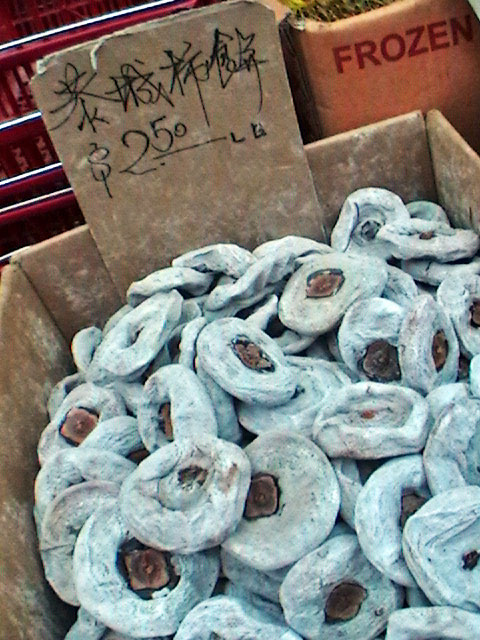
Dried Persimmons

Persimmons are one of my favorite fruits because are sweet but not too sweet. Dried Persimmons are awesome. It's nearing the celebration of the Lunar new years in Chinese and Vietnamese culture (I think Korean too, not sure. I know that Japan has abandon it's lunar calender for the solar one.) So that means that there are much dried persimmons to be had, not that you couldn't buy them all year round of course.

Sonntag, 27. Dezember 2009

Congee


In Khmer babar (no the elephant of course).

Depending on serving, us from 2 to 4 cups of white rice. Put double or more amount of water, depending on how liquid you want it.

You can put a multitude of yummy things in congee. I put chicken, parsley, chives, pepper, and salted soybeans. Also shredded pork is good too.

I can't think of an east Asian nation that doesn't serve conjee. I remember getting it even on EVA Air on my way to Taiwan. (I didn't enjoy it because I was afraid of dying on the whole trip there.) Some of the best conjee I've eaten are Korean and Cambodian conjee which sometimes use ingredients that would look weird in western food.

Montag, 10. August 2009

YUM! Larb!


Yummy stuff! The first time I tried this fine Lao-Thai cuisine, it was so exotic. Supprisingly, it doesn't exist in Khmer food despite being so close that region of Thailand where it's the specialty. You can find the recipe at this link! http://www.thaitable.com/Thai/recipes/Laab.htm